
Inland Regional Center Housing: Life-Sharing Options in the Inland Empire
The Inland Empire is one of the fastest-growing regions in California. Riverside and San Bernardino counties added more than 200,000 residents in the last decade. New neighborhoods, new shopping centers, new freeway lanes. But housing options for adults with intellectual and developmental disabilities (IDD) have not kept pace. Families across the region are still choosing between group homes with long waitlists and staying at home with aging parents who worry about what comes next.
Inland Regional Center (IRC) serves this entire territory. That means everything from Corona and Temecula in western Riverside County to Victorville and Barstow in the high desert, from Fontana and Ontario in the west valley to Palm Springs and Hemet in the east. It is one of the largest Regional Center catchment areas in the state, both in population and square miles. And the housing gap is felt in every corner of it.
There is a path forward that most families in the Inland Empire have not heard about yet: life-sharing through Supported Living Services.
The Housing Landscape for Adults with IDD in the Inland Empire
For years, the default options for adults with developmental disabilities in Riverside and San Bernardino counties have been limited. Most families know about group homes. Some have heard of Supported Living Services. Very few know about life-sharing.
Here is what families typically encounter when they start looking:
Group homes with four to six residents, shift-based staff, and structured schedules. These work well for individuals who need 24/7 eyes-on supervision or have complex medical needs, but they offer limited privacy, limited choice, and limited independence.
Staying at home with parents or siblings. This is the reality for the majority of adults with IDD in the Inland Empire. It works until it does not — when parents age, when caregivers burn out, when the adult child wants a life of their own.
Traditional apartments with drop-in SLS support. A good option for people who are highly independent but still need some assistance. The challenge is that living alone can be isolating, and finding a landlord willing to work with SLS providers in a competitive rental market adds another hurdle.
What is missing from this picture is a housing model that combines real independence with built-in companionship and consistent daily support. That is exactly what life-sharing provides.
What Life-Sharing Looks Like Through IRC
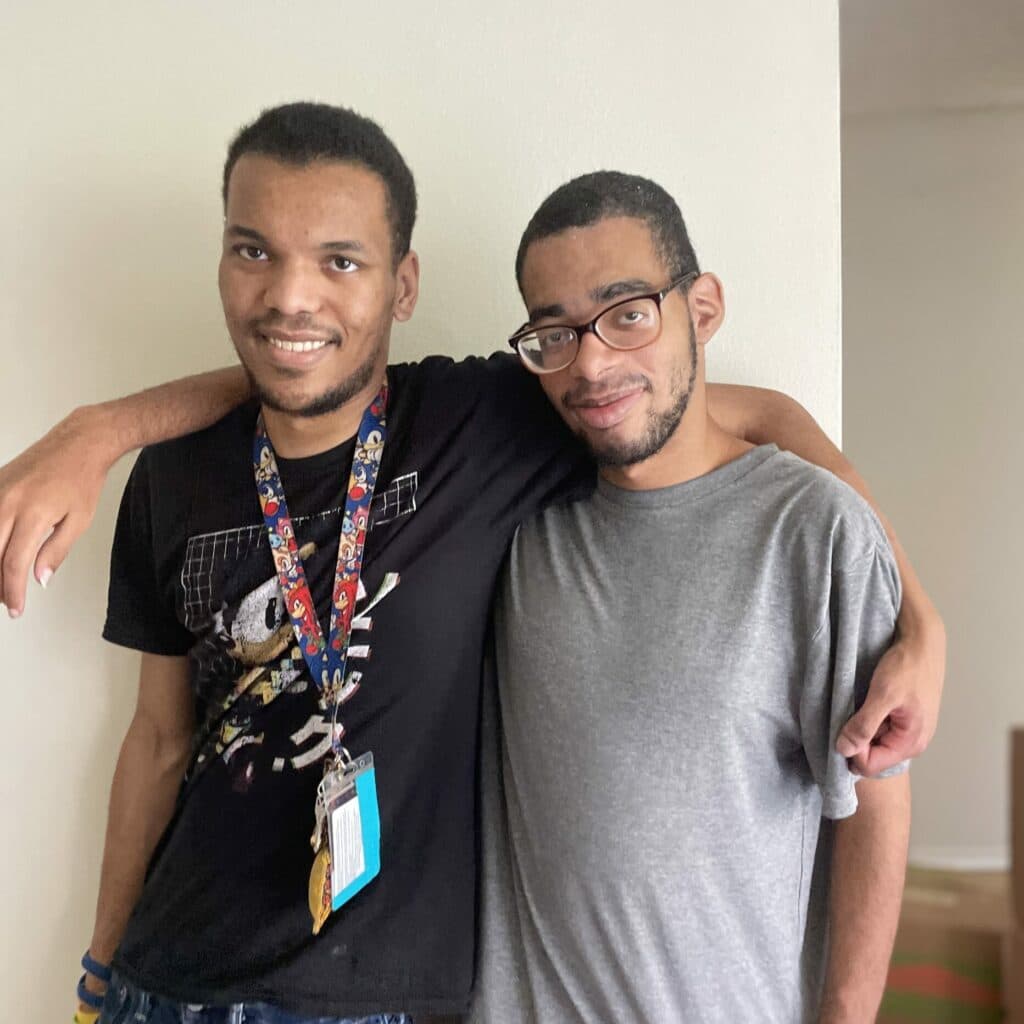
Life-sharing is a specific model within Supported Living Services (SLS) where an adult with IDD is matched with a compatible supportive roommate. The two share a regular apartment or house in the community. The roommate provides daily support — help with cooking, budgeting, transportation, appointments, social activities — while also being a genuine companion. Not a rotating shift worker. Not a clinical caregiver. A person who shares meals, splits chores, watches movies on the couch, and becomes a real part of each other's life.
This is funded through the Regional Center system. Most families pay nothing out of pocket. The supportive roommate receives compensation through SLS funding, which means they are trained, committed, and financially supported to be there consistently.
For cities across the Inland Empire — Riverside, San Bernardino, Rancho Cucamonga, Moreno Valley, Redlands, Upland, Murrieta, Ontario — life-sharing opens doors that group homes and solo apartments cannot. Rent is more affordable when shared. Isolation disappears when someone is there every day. Independence grows when support is woven into the fabric of daily life rather than delivered on a clinical schedule.
Homies works directly with IRC to provide life-sharing placements across the Inland Empire. We handle the roommate matching, the housing search, and the ongoing support coordination. Our matching process goes deep — personality, interests, lifestyle, communication style, support needs — because getting the match right is what makes life-sharing work long-term.
How to Request SLS and Life-Sharing Through Your IRC Service Coordinator
If your family member is already an IRC client, here is how to get started:
1. Contact your IRC service coordinator. Every IRC client is assigned a service coordinator. If you do not know who yours is, call IRC's main office and ask. Tell them you want to discuss housing options and Supported Living Services.
2. Request an Individual Program Plan (IPP) meeting. The IPP is the document that outlines your loved one's goals, needs, and the services they will receive. Housing and SLS must be written into the IPP for funding to be authorized. You have the right to request an IPP meeting at any time — you do not need to wait for the annual review.
3. Ask specifically about life-sharing and supportive roommate options. Service coordinators know about group homes and traditional SLS. Some are less familiar with life-sharing as a distinct model. Be direct: tell them you are interested in a life-sharing placement where your family member would be matched with a supportive roommate through an SLS provider like Homies.
4. Get a referral to Homies. Once SLS is approved in the IPP, your service coordinator can refer your family member to Homies. We will set up an introductory call to learn about your loved one, discuss what they are looking for in a roommate and living situation, and walk you through the timeline.
If your family member is not yet an IRC client but has a developmental disability diagnosed before age 18, they may be eligible for Regional Center services. Contact IRC directly at inlandrc.org to start the intake process.
Why Life-Sharing Is Gaining Ground in the Inland Empire
The Inland Empire has something that many parts of Southern California do not: housing that is still within reach. Compared to coastal Orange County or West LA, rents in cities like Riverside, Fontana, Moreno Valley, and Temecula are significantly more affordable. That matters for life-sharing, because it means two people splitting a two-bedroom apartment can live in a safe, comfortable neighborhood without stretching the budget.
The region also has a strong sense of community. Neighborhoods in Redlands, Rancho Cucamonga, Upland, and Corona are built for the kind of daily life that makes life-sharing thrive — walkable streets, local parks, coffee shops, grocery stores, community events. Life-sharing is not about being hidden away in a facility. It is about being part of the neighborhood.
For families navigating these decisions, and for adults with IDD who want to explore their options, life-sharing through IRC represents something that did not exist in the Inland Empire five years ago: a housing model that treats independence and companionship as things that go together, not things you have to choose between.
Take the Next Step
If you are an IRC client or family member exploring housing in the Inland Empire, reach out to Homies. We will walk you through how life-sharing works, answer your questions, and help you figure out whether it is the right fit — no pressure, no commitment required.
Visit our Inland Regional Center page to learn more, or head to How It Works to see the full process from first call to move-in day.
Ready to explore life-sharing?
Schedule a free 15-minute call to learn how Homies can help your family. No commitment, no pressure — just answers.